Extreme concentrations of wealth and power have profound impacts on our politics and on our daily lives.
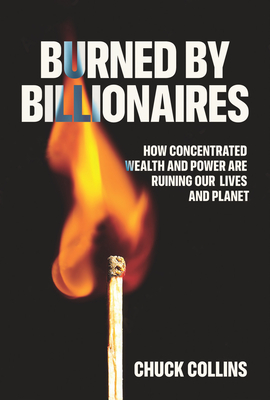
That’s the take of Chuck Collins in his new book – Burned by Billionaires: How Concentrated Wealth and Power are Ruining our Lives and Planet (New Press, 2025).
Collins takes down the “myth of meritocracy,” unraveling how the rich rig the game in their favor, resulting in a concentration of wealth in the hands of a tiny (but growing) class of billionaires (900 in the United States and counting) – leading to intense income and political polarization.
Collins argues that this concentration of wealth and power is leading to political hijacking, undermining the democratic principle that our votes matter equally.
Collins opens his new book with a fascinating geography of wealth in America.
At the bottom are the precariat – composed of the sixty to seventy percent of Americans who are living paycheck to paycheck. These Americans are one car repair or emergency room visit away from financial ruin.
At the top is Richistan.
First you have Affluent Town. This is home to the top three to ten percent of the American people. Wealth in this group starts at $1.5 million and annual household income starts at $110,000. It consists of a group of 9 million people.
Then there is Lower Richistan. This includes the top three percent of wealth holders, excluding the wealthiest one percent. These 2.6 million households have wealth between $6 million and $13 million. Their annual incomes range between $180,000 and $300,000.
Next is Middle Richistan. These are the top one percent of wealth holders – about 1.3 million households with assets over $13 million, with an average of $37 million in wealth.
Then there is Upper Richistan, home to 130,000 Americans with wealth ranging from $60 million to $1 billion. Average income starts at $1 million a year and goes up.
At the top is Billionaireville. These are the 900 wealthiest Americans with assets of more than $7 trillion – more than half of the combined wealth of the entire rest of America’s 65 million households combined.
What to do about this wealth inequality?
Collins would limit wealth.
Cap it at $40 million.
Impose a 100 percent tax on everything above that.
“You have the top ten percent of households – Affluent Town,” Collins told Corporate Crime Reporter in an interview last week. “They will often work for the billionaire class as financial advisors or provide other services to the ultrawealthy. They are super-identified with the wealthy. And then it proceeds up to the 26 people in the United States who each have $50 billion or more. That’s mostly the new tech money and artificial intelligence money that is driving much of the disruption right now.”
“Different levels of wealth have different levels of consumption, power and influence.”
You say the millionaire class is about nine million households. But then the billionaire class is only 900 people total.
“In 1983, there were about 15 billionaires on the Forbes list. As of today, there are 920 billionaires in the United States with a combined wealth of over $8 trillion. That is up from $3 trillion just five years ago.”
“Upper Richistan has about 130,000 households. Those are people with $60 million and up. That’s the top 1/1000 of households. That’s where the wealth and power reside most intensely.”
“Financial managers talk about ultra-high net worth individuals as the top one-tenth of one percent – that’s $30 million to $40 million and up.
That’s where wealth converts to power. That’s the level where people hire the wealth defense industry, the tax attorneys and accountants. This is this vast army of wealth hiders who play shell games with the wealth and convert it to assets that can’t be easily traced.
Not to say that someone with $20 million couldn’t afford that army.
“Those people with $20 million are beginning to afford that. But at the higher levels, people have family offices devoted to their own wealth and to wealth management and charity activities. If you have $20 million you are doing great, your kids are fine, you are living the frictionless life, you have multiple homes. But you are not wielding the level of power wielded by the people in Upper Richistan and Billionaireville.”
You raise this in the beginning of your book – whether this is deserved wealth. I can sit at my computer and order some coffee filters and it arrives the next day. Don’t have to leave home. Aren’t the billionaires who built that system deserving of that wealth?
“There is a stage of wealth accumulation where people start a business and create something useful and they are rewarded for it. I like all kinds of amenities that have emerged in the last twenty years or so. But once people reach a certain level of wealth, they start to use their power to defend their wealth, block competition, engage in lobbying and influence for purposes of political capture, and then there is hypextraction.”
“That’s when you have so much wealth that you are deploying a portion of it to extract wealth from the real economy. You are moving your wealth into private equity to plunder the health care system or the housing market, or any number of ways in which we are being squeezed.”
“That’s part of the affordability crisis we are experiencing. The cost of groceries is going up. Why? In part, because there is this wealth extraction.”
“In the United States, we have a story of wealth and deservedness which is very powerful. But that’s not how you become a billionaire. You become a billionaire because you have blocked other competition, you have changed the regulatory environment or you have just inherited it. A huge amount of that wealth flows to people whose main work is to pick your parents.”
You are saying that no billionaire came about it honestly?
“There is the famous saying – behind every great fortune is a crime. I would say – behind every great fortune is maybe an entrepreneurial moment, creating something useful that consumers are willing to pay money for. But at a certain point, that translates into power and they use that power to rig the rules to get more wealth and power. It becomes less about deservedness and more about power.”
Ralph Nader wrote a book – Only the Super-Rich will Save Us. Aren’t there exceptions in the billionaire class, philanthropic souls who amass their billions and then give it away for good works?
“There are distinctions between people in the billionaire class. By the way, I love that novel by Ralph Nader. And if there were a few billionaires who wanted to fund organizing to protect democracy, the book lays out where the investments could go. And some of the billionaire fortunes are less extractive. Some of them will say – I don’t need to be a billionaire.”
“Chuck Feeney made his billions from duty free shops. He probably had $9 billion at one point. He gave it all away during his lifetime. And he died not being a billionaire.”
“There are people who make different choices. Tom Steyer uses his billions to try and address the climate crisis. There are a few who we could lift up and say – yeah, they are not evil incarnate. But at a certain point there is a system driving this where we are on concentrated wealth autopilot.”
“There is something called the Giving Pledge where 280 billionaires said – I’m going to give away at least half my wealth in my lifetime. And we just did a fifteen year look at that. And what we found is that for most of them, their wealth is accelerating in growth. Their wealth isn’t diminishing. Even if they are aggressively giving it away, their wealth just keeps multiplying. And much of that goes into family foundations and donor advised funds. So it’s not even leaving the domain of these ultra-billionaires. It’s still in their control.”
“The bottom line is – charity is not a substitute for a fair tax system where the rich pay their fair share.”
There are activists who say – there should be no billionaires. You don’t like that rhetoric.
“Some people hear that as an elimination, or extermination rhetoric. That might not be their intention. But what people hear is – no billionaires and they are going to be led to the gallows.”
“If we want to appeal to a wide audience, it’s helpful to say something like – we don’t want an economy where the rules are rigged to funnel wealth upward to the billionaire class. What we want is a society with fewer billionaires or no billionaires and more thousandaires. And there are capitalist economies around the world that have fewer billionaires because they tax wealth and invest it in policies that lift everyone else. That’s what we want.”
“Billie Eilish the singer said the other day – “If you’re a billionaire, why are you a billionaire? No hate, but yeah, give your money away.”
That’s more of the message we want to send. It’s saying – you have too much, and too much is bad for everybody. Give it away or better yet, let us tax it away and support policies that lift everyone up.”
“We know from history that when we have these extreme inequalities, societies either break down or the wealthy are led to the guillotine. Taxing the rich is a fair compromise.”
Should there be a limit on wealth?
“I think so. From Franklin Delano Roosevelt, during the Great Depression, or going back to Tom Paine, people were saying – there needs to be a 100 percent tax on wealth above a certain level because that level of wealth undermines democracy.”
“And in Europe, Ingrid Robeyns wrote a book called Limitarianism. And she says – yes, we should have absolute caps on wealth at a fairly high level. If they need more than $40 million to innovate, then they are more sociopathic.”
“I think we should set caps on wealth at a high level and not allow people to opt out by giving it away to a foundation. There should also be a cap on how much you get to deduct from your taxes by donating to a charitable entity.”
Maybe I missed it, but I didn’t see in your proposals at the end of your book a proposal to limit wealth.
“That’s true. It’s a conversation that is emerging.”
Why didn’t you say – yes, let’s limit wealth?
“Part of it is I didn’t see all the threads of these movements coming together. Whenever someone proposes caps, you get this meltdown. In retrospect, I wish I just came out more boldly and said – at a certain level, we should cap and tax away wealth above a certain level – a 100 percent tax on wealth above x million.
What would you put it at?
“I would put it at $40 million. Above that you are creating dynastic wealth, wealth that would lord over the rest of society for generations.”
How many have more than $40 million?
“Probably about 130,000 households. These are powerful, highly engaged politically – they are super agents. They have way too much power relative to the rest of us.”
Much of this wealth is derived from corporate criminal activity.
“The corporate form is one of the key mechanisms of wealth extraction from the rest of society. When you have a billion dollars or $500 million, you are moving money into the casino economy. You are putting the money into a private equity fund with the goal of getting a 25 percent to 30 percent annual return on investment.”
“How do you get that kind of return? You need to monopolize and control and extract rents from many people. You need to own an app where everybody who goes through your portal sends you money.”
“Or you own an emergency room where people don’t have a lot of say over what they are getting charged. Or you buy a mobile home park. One of the mobile home park investors says – I love buying mobile home parks. It’s like buying a Waffle House where the customers are chained to the counters. They have no choice, they just have to pay me.”
“That’s the model of plunder and wealth extraction we are talking about. That and the corporate form and the private equity firms are the mechanisms used to pull wealth upwards.”
“We are going to see our first trillionaire in our immediate lifetime. Even the Patriotic Millionaires – a network of these 350 millionaires – including a few billionaires – are saying – yes, the real power is up there, higher up. It’s in Billionaireville and Upper Richistan.”
[For the complete q/a format Interview with Chuck Collins, 39 Corporate Crime Reporter 467(12), December 1, 2025, print edition only.]