The United States spends nearly a trillion dollars a year on its military. This spending not only detracts from our ability to address pressing social problems but compels us into foreign wars to justify our vast arsenal. Sold to us in the name of security, our military industrial complex actually makes us far less safe.
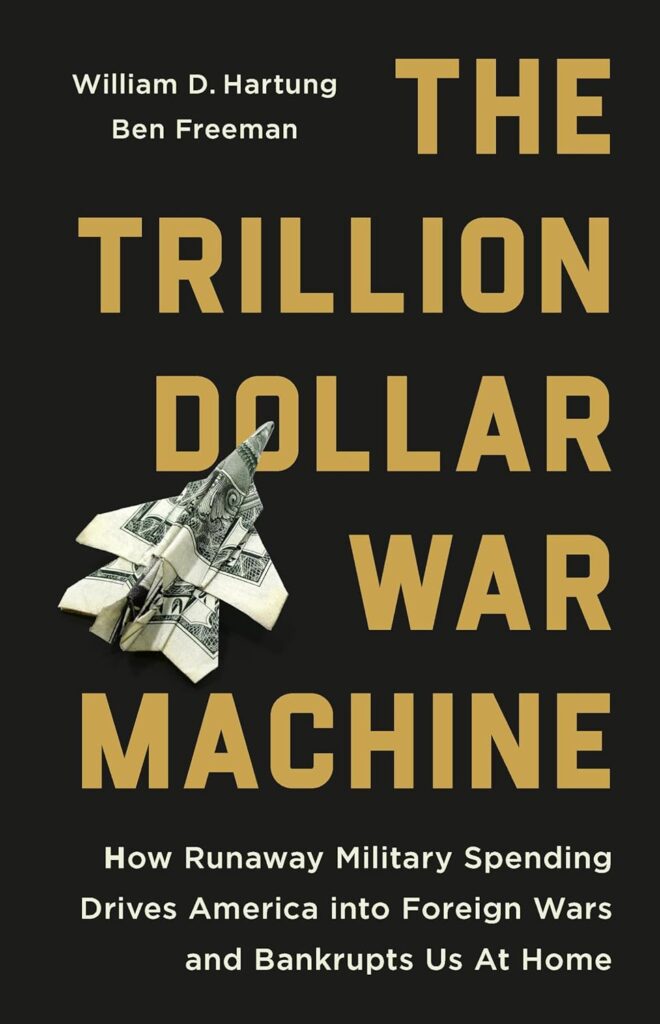
That’s the conclusion of William Hartung and Ben Freeman in their new book – The Trillion Dollar War Machine: How Runaway Military Spending Drives America into Foreign Wars and Bankrupts Us at Home (Bold Type Books, November 2025).
Hartung and Freeman follow the profits of militarism from traditional Pentagon contractors, which receive more than half of the Pentagon’s budget, to the upstart high-tech firms that promote unproven and destabilizing technologies.
They unmask the enablers of the war machine – politicians, lobbyists, the media, Hollywood, and think tanks – whose work enriches a wealthy elite at the expense of everybody else, spreading conflict around the world and embroiling America in endless wars.
If you were to describe the war machine in a nutshell, what would it look like?
“We call it the war machine, because it’s a bit different from the military industrial complex that President Eisenhower talked about. It’s much larger now,” Hartung told Corporate Crime Reporter in an interview last week. “The Pentagon’s budget is about twice what it was, adjusted for inflation, when Ike gave his speech in 1961. You have these huge companies like Lockheed Martin, which has $40 billion to $50 billion in Pentagon contracts every year, builds many different kinds of weapons, has huge influence with the government, and claims that its jobs are essential in most Congressional districts.”
“Eisenhower would never have dreamed of a company that large and influential. And now of course we have the Silicon Valley militarists who are much more vocal and hawkish and have a worldview that suggests that technology will be our savior, that they are superior beings who know what the United States’ role should be in the world, and how our government should work.”
“And this is a terrifying bunch. They are not equipped to analyze foreign policy. One of them is a former gamer, one of them spends a lot of time trying to figure out how he can live forever, and of course there is Elon Musk’s mass colonization of space. In addition to the dangers of the technology they are pushing, it’s a dangerous ideology they are trying to promote. And some people fall for it because they admire technology, they think it’s cool and amazing. It’s just another ideological barrier to taking a realistic look at what our foreign policy should be.”
“And we also look at soft power – the Pentagon’s influence over Hollywood, the gaming industry, the universities, the media, flyovers at sporting events. It’s not just spending money on campaigns and hiring government officials to lobby for you, or even playing the jobs card. They have those other influences that are embedded in our society. It reinforces some of our founding myths of American exceptionalism, that more spending on the military is better because it’s kind of an insurance policy, that America is the good guy in the world despite the devastation of all of our wars.”
“We wanted to take it on as the whole, not just one individual piece and try to figure out what we can do about it, which is no small task.”
You also address the question of the military industrial Congressional complex. And you say there are almost 1,000 war machine lobbyists on Capitol Hill. How many anti-war machine lobbyists are there on Capitol Hill?
“We have the Friends Committee on National Legislation. They may have as many as ten lobbyists, but they work across a range of issues. They have one who does Pentagon and nuclear issues. A few other places have 501c4 organizations. I would say if we had a dozen we would be lucky. So it’s a dozen compared to 945.”
“Of course, if I walk into a Congressional office, I try to get them to do the right thing. Lockheed Martin walks in and they are offering campaign contributions, jobs in their district, the chance to wrap themselves in the flag. Many Democrats are still afraid of being viewed as soft on defense even though hawkish policies have been a complete disaster during this century.”
“Our only chance is to get people engaged. The Friends Committee is careful to have a range of folks going to the Congress – traditional peace activists, a business or a religious leader, someone who knows someone in the member’s network. It’s a fine art, but we need more of that. If we combine that with trying to break through the propaganda of the war industry, that’s our best shot.”
There used to be members of Congress who were stronger anti-war machine voices. People like Senator William Proxmire and who else?
“Senator William Fulbright. There were people who voted against the Tonkin Gulf resolution like Senator Wayne Morse. There were people who weighed in against the CIA assassinations. There was a whole group – Frank Church, George McGovern, James Abourezk, Fred Harris, Morris Udall.”
“And that has now changed. You used to even have moderate to liberal Republicans who would vote with progressives on certain issues. And you had a reform caucus in the 1980s who said – the weapons are too expensive, they don’t work, these companies are ripping us off, we need cheaper and more reliable systems, you need to give the troops a chance. They had 100 members in the House. Even Newt Gingrich was a member. And they provided some counterweight.”
“And the members paid more attention. When they had the spare parts scandal with the $500 hammer and the $700 toilet seat, there were televised hearings. There were major news stories. Late night comedians were making fun of it. Herb Block, the Washington Post political cartoonist, whenever he portrayed Reagan’s defense secretary Caspar Weinberger, he drew a toilet seat around his neck.”
“Congress had some support in the media and in the broader society to defend this kind of stand. It’s much the contrary now. People are vilified for calling for a ceasefire in Gaza. They are run out of Congress by AIPAC and others. They are called traitors.”
“There are a number of courageous members still standing – Ro Khanna and Elizabeth Warren, Mark Pocan. There is an arms control caucus with people like Ed Markey. But they are the exceptions. Bernie Sanders has done some great speaking, but to actually win legislation in this climate is very difficult.”
“There’s not a lot of political benefit for a member to stand up and speak out. We don’t have the kind of countervailing public force that is going to reward them for taking those stands. It’s up to us to figure out how to transform the political incentives so that more members do stand up.”
Even with members like Bernie Sanders, they have military bases in his district. That has to weigh on him.
“If you don’t have the latest aircraft at your military base, your base is subject to being closed. Bernie said – I’m against the F-35, but as long as it exists, I’m willing to have it in my state. He was treading that line. But often, liberals will not vote against a weapon built in their state. And then they make a deal from somebody from another state – you vote for my weapon and I’ll vote for your weapon. And that pretty much locks it up.”
“There were exceptions. John Tierney, who now runs the Council for a Livable World, would vote against these weapons systems in his district in Massachusetts. Tom Andrews from Maine pushed for economic conversion. He said – we have too many military bases in my state, I think we should close one of them. His career ended when he ran against Olympia Snowe for the Senate in Maine. So people are not always rewarded for taking those positions.”
“But now is the time for people to take some risks politically given the devastating consequences of these wars. We are paying a huge price with business as usual. And we can’t afford to do it anymore.”
In your book, you give an example of Palantir’s CEO Alex Karp who in February, 2024 told investors that he was exceedingly proud that after October 7 “within weeks we were on the ground and we are involved in operationally crucial operations in Israel.”
And in January 2024, Karp held the company’s board meeting in Tel Aviv as a sign of support for Israel and its war in Gaza. Karp said that part of the reason for holding the meeting in Israel was to “embarrass other people who are pro-Israel in private but somehow not in public,” including his fellow tech executives. There appears to be a more brazen attitude among the tech bros.
“Yes, the Peter Thiels and Palmer Luckeys are unabashedly hawkish and militaristic and also all in with Trump. The big defense companies traditionally split their money about 60/40 in favor of the party in power. If they talk about war, it would be in muted terms. If they are on an investor call, they might say something like – “turbulence should increase our business, helping our allies promote stability.” It’s not like Palmer Luckey going on 60 Minutes and proclaiming that there is going to be a war with China in two years and we are going to make sure we win. Or Palantir unabashedly promoting mass slaughter in Gaza.”
“So they have that aspect. But they are selling themselves as the new kids on the block, they are more competitive, they’ll put some of their own money in. Anduril Industries put out a report a couple of years ago titled – Retooling the Arsenal for Democracy – which is a pretty good critique of the corruption of the big companies. Ben and I could have written it. But it was written for a particular purpose. They want to replace Lockheed Martin as the big contractor. And they are more hawkish. So we don’t want to hitch our wagon to them.”
“They might trash each other and some interesting information might emerge. But the other possibility is that the government will pay off both sides. For things like Golden Dome, they have already said they will use existing hardware, which would be Lockheed Martin, Boeing and Raytheon. But the software and integration will probably be SpaceX or Anduril or one of these Silicon Valley corporations. Even the new fighter planes are going to have unmanned wingmen which could go to one of the Silicon Valley companies.”
“One danger is if the Pentagon pays them both off, the one trillion dollar budget will be just the beginning. The tech firms are much more out there. They have a chief ideologist who writes these articles about the founders – like the founding fathers. They say things like – it’s the God given understanding that only you can do this.”
“A lot of reformers feel this conflict is an opportunity. And in one sense yes, it probably takes a billionaire to break up and disrupt those big companies. But be careful what you wish for. We have to keep an eye on those folks. We have to regulate them. If they have a widget that works, buy it. But don’t let them dominate your foreign policy, your budget, your culture. They are way out there. And they have to be confronted vigorously and not just assume that they are the next big thing that we should throw money at.”
You write about the Senate ICBM Coalition. What is that?
“You wouldn’t think it would be that strong. It’s senators from smaller states that have ICBM bases or work on them – Utah, Wyoming, North Dakota, Montana. But they have been quite effective. The Democrats in that group are now gone. They have been defeated at the polls. When the new START Treaty came up, they put a floor on how many ICBMs we could get rid of. There is now actually a provision of law that says you can’t go below 400 ICBMs. Even for the empty silos, they said – don’t get rid of them, we might want to build up again. They don’t want to have any studies of alternatives, even if it is just – don’t build a new one, just extend the life of the old one. They have been remarkably effective. That’s because companies like Northrop Grumman are behind it.”
“Fred Kaplan, who has analyzed this, showed that when they came up with the Nuclear Triad back in the 1950s – land based, submarine based and bomber based nuclear weapons – it wasn’t because of some big strategic theory, it was because both the Navy and the Air Force wanted a piece of the nuclear budget. The profiteering goes all the way back to the beginning of the nuclear age.”
[For the complete q/a format interview with William Hartung, see 39 Corporate Crime Reporter 46(12), November 24, 2025, print edition only.]