In 2007, Ana Malinow was president of the nation’s premiere public interest group pushing for single payer national health insurance – Physicians for a National Health Program (PNHP).
But a couple of years ago, Malinow, a retired pediatrician, helped start a separate group called National Single Payer.
The difference between the two groups?
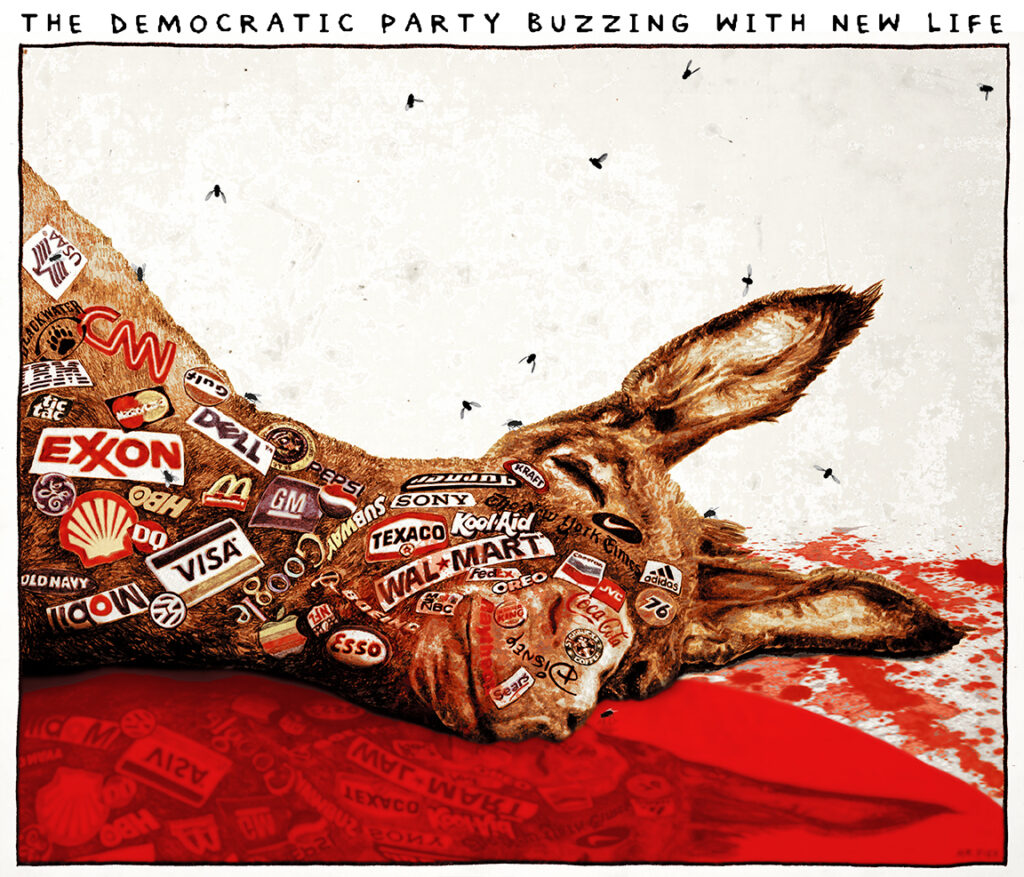
PNHP is tightly aligned with the Democratic Party. National Single Payer is not.
When we ran an article last week calling out the problem of PNHP and the Democratic Party, we received an email from Malinow.
“Thank you for your recent article – Genocide the Non Profit Industrial Complex and the Democratic Party,” Malinow wrote.
“It is important to call out organizations which have lacked the moral courage to speak out against the genocide in Gaza.”
“In contrast to PNHP – to which many of us still belong, if only marginally – National Single Payer strongly condemned the genocide early on.”
“In August 2024, I published an article exposing the lack of moral courage among medical professional organizations, which were staying silent, and thus complicit, in the genocide.”
“To coincide with our nation’s 250th anniversary of the Declaration of Independence, National Single Payer launched a campaign – The Declaration of Independence from the Medical-Industrial Complex.”
“We believe that it is time for the people to rise up, organize, take control of the healthcare system, and run it in the interest of the public instead of in the interest of profit. It’s time for comprehensive, universal, national Medicare for All, free from profit.”
“As we approach the midterms, and the general election in 2028, Democrats offer us half-measures: meaningless proposals that prop up the Affordable Care Act and misleading schemes like Medicare by Choice.”
“A profit-driven system cannot be repaired with incremental fixes. We have the hard facts from a century of failed attempts to prove it.”
“It is critical for us to go on the offensive now, before we lose this window of opportunity, and politicians (and the non-profit industrial complex, which we call out in the Declaration) derail our movement again.”
You are a retired pediatrician and are on the steering committee of National Single Payer. Back in 2007 and 2008, you were president of the most prominent single payer group – Physicians for a National Health Program (PNHP).
You are still a member of PNHP. Why was there a need for yet another single payer group – National Single Payer?
“PNHP is mostly physicians and allied health professionals,” Malinow told Corporate Crime Reporter in an interview last week. “National Single Payer is for everyone – whether you are a health professional or not. We are joined by the common principle that healthcare is a human right, must be free, not for profit and will be achieved through national legislation and not a state by state effort.”
Is PNHP open to state single payer?
“Yes. The Metro NYC PNHP chapter and the California state chapter spend a lot of their time and effort advocating for state single payer.”
Do you know whether the national board of PNHP addressed the question of genocide.
“I do not. I’m not a member of the board of PNHP and have not been for many years. I couldn’t say. I am an advisor to PNHP.”
PNHP is closely aligned with the Democratic Party, right?
“Yes, there has always been a relationship between the Democratic Party champions of single payer and PNHP. And one issue is that the Democrats propose single payer bills but do nothing to mobilize around that bill. That becomes problematic.”
What is National Single Payer doing differently?
“Back in November 2023, National Single Payer published a statement denouncing the Israeli targeting of hospitals in Gaza and the U.S. complicity in the genocide. There was some backlash, but we also received praise for our stance. And since then, National Single Payer has published statements not only on Gaza, but also on Iran and Venezuela. In 2024, National Single Payer led a delegation to Cuba to deliver medicine and learn about the Cuban healthcare system.”
“We are also a signatory to Doctors Against Genocide and the Sanctions Kill campaign. It is important that we connect the violence of this medical industrial complex to the broader machinery of empire. The same political system willing to fund wars, sanctions, occupation and genocide, also accepts this mass suffering in the United States. Violence abroad and austerity at home are part of the same ideological structure.”
“As our government pours trillions into the military industrial complex that devastates public healthcare systems abroad, we are also destroying healthcare, dignity and life expectancy right here in the United States. As an organization that promotes healthcare as a human right and single payer, we have to connect the dots. Healthcare will never become a human right until we the people confront this profit driven system that feeds on human suffering.”
“And that’s why National Single Payer has launched a campaign called the Declaration of Independence from the Medical Industrial Complex. Both the military industrial complex and the medical industrial complex are profit driven machines functioning exactly as designed – enriching corporations as people suffer.”
You said you did face backlash for taking a stance on the genocide. What was the backlash?
“Members of National Single Payer left the organization because they didn’t think we should be making these kinds of statements opposing the genocide and U.S. complicity in the genocide.”
Have any other single payer groups spoken out?
“While national PNHP has not made a statement about the genocide, several local and state chapters have spoken out and made public statements about the genocide. The New York Metro PNHP and the PNHP Bay Area chapters both made strong statements.”
Does National Single Payer stand for government run health insurance like the UK? Or is it just the government running the insurance program?
“The bill that sits in Congress right now – HR 3069 – is a national health insurance program that would eliminate private insurance companies. Medicare would then negotiate with pharmaceutical companies and give us comprehensive health benefits. All of those things are very important. But unfortunately, it does not call for the conversion from for profit to not for profit status of the hospitals for example. It does not put the screws on not for profit health systems.”
“What does this mean? This means that the healthcare delivery part is still in private hands. And so you are still going to have Optum, which is a subsidiary of UnitedHealthcare, controlling 90,000 doctors. It will allow private equity to run our emergency rooms. It’s going to allow two for profit corporations to run almost all of our dialysis centers. Many hospice companies and nursing home facilities are investor owned. That’s the delivery part of our healthcare system that needs to be changed.”
“When we talk about single payer, we are talking about the financing part of our healthcare system. It doesn’t address the delivery system. That’s why we think that the Medicare for All bills sitting in Congress need to be improved. Most importantly, they need to call for the conversion of the for profit delivery systems to not for profit.”
Otherwise it becomes a public subsidy of this medical industrial complex.
“And your next question would be – are you crazy?”
There is no legislation in Congress that would do that?
“No. HR 676, the bill introduced by John Conyers, did call for the conversion of the delivery system to not for profit. And that might turn it into a national health service like the UK.”
“In the UK, all hospitals are owned by the government. The doctors and health professionals work for the government and are paid by the government.”
“Steffie Woolhandler and David Himmelstein wrote a great article in the Nation several years ago titled Medicare for All is Not Enough. They argue that healthcare should be owned by the community that it serves. We need to start talking about what that would look like.”
HR 676 called for the conversion of all of the healthcare facilities from profit to not for profit. But we have giant not for profit hospitals now that act just like for profit hospitals.
“They do because they are entrenched in a system that incentivizes that kind of profiteering.”
If you were in Congress, what would you do differently from what Bernie Sanders and Pramila Jayapal are doing in pushing for change?
“I would sit down with National Single Payer and come up with a way to improve the Medicare for All legislation. One is the transition to non profits. One is the just transition of workers who are going to lose their jobs in the private health insurance industry. Another is the transition time. We do not need a two year or four year transition as Sanders is proposing. We do not need the inclusion of a public option. And I would include progressive tax funding.”
“Then I would hold hearings to draw attention to the issues. And we would insist that when someone signs onto the bill, they need to do more than just sign and move on. They need to hold town halls about it. They need to advocate for it. They can do something called special order speeches.”
The Democrats are famous for diverting attention from single payer. You call these proposals off ramps. One was famously the public option that Howard Dean was pushing. He said – give people the option of signing onto Medicare if they want. Don’t require it.”
“The Democrats are now proposing two of these off ramps. Both are designed to preserve private insurance dominance while creating the illusion of reform.”
“Senator Ron Wyden wrote a dear colleague letter that promises policies to lower the cost of health insurance. That’s one proposal coming out of the Democrats in Congress.”
“The other proposal is from the Center for Health and Democracy that Wendell Potter runs. He calls it Medicare by Choice. It allows for the option of enrolling in traditional Medicare regardless of age. That is just a rerun of the public option.”
“But the rules are set up to make the private option succeed and the public option fail.”
“These proposals are dangerous and they are off ramps for candidates in 2028 who don’t want to push for Medicare for All. They are guaranteed to set the Medicare for All movement back another fifteen years, just like the Affordable Care Act did. And you can see the propaganda machine starting to churn.”
“We should not miss this opportunity to secure national single payer. It’s time to declare independence from the U.S. medical industrial complex. We cannot be distracted and we must seize this moment to build an uncompromising movement capable of confronting the medical industrial complex directly.”
[For the complete q/a format Interview with Ana Malinow, see page 40 Corporate Crime Reporter 25(12), June 15, 2026, print edition only.]